
Technical / Calculation Methods

Outdoor noise calculation methods with defined implementation scope.

dhwaniPRO calculates outdoor sound propagation using implemented acoustic methods and spatial site geometry. ISO 9613-2:2024 is available across all editions, while Vector and Delta also provide a dedicated CNOSSOS-EU calculation pipeline.

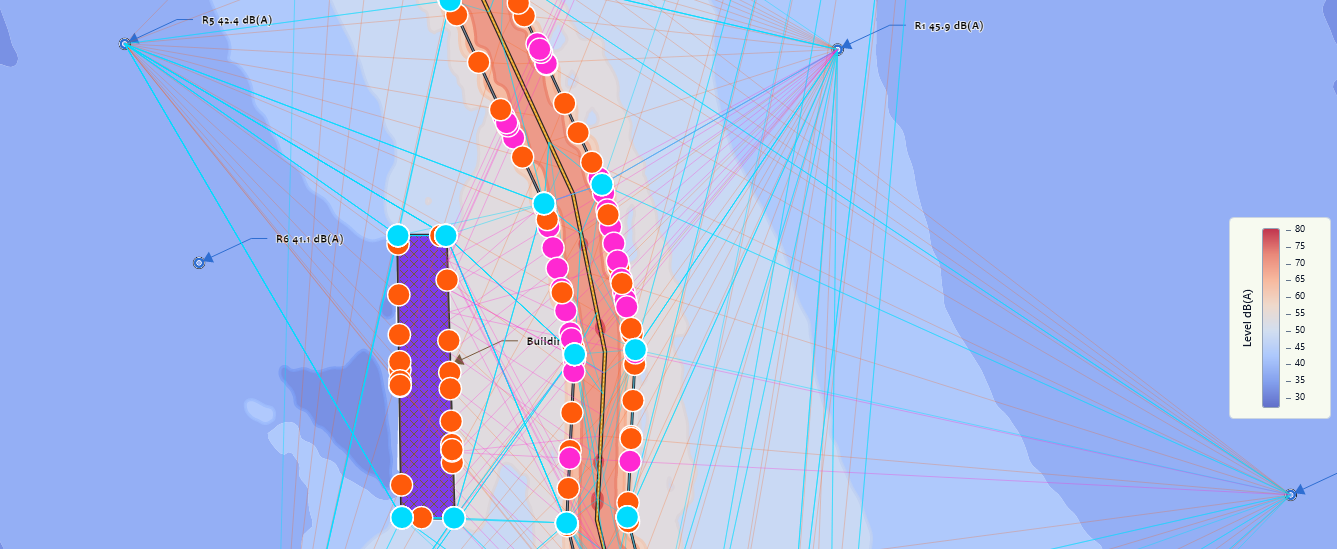
Calculations process eight octave bands and account for applicable propagation effects, including distance, atmospheric absorption, ground effect and diffraction. Advanced editions extend the treatment of complex source-to-receptor paths.

dhwaniPRO showing sound propagation
			   paths between sources and receptors
			   around buildings and barriers
dhwaniPRO: Source-to-receptor propagation paths around represented site geometry.

Implemented Methods

Two defined propagation pipelines.

ISO 9613-2:2024 and CNOSSOS-EU are distinct implemented methods. Their availability and applicable calculations should not be treated as interchangeable.

ISO 9613-2:2024

All Editions

The second edition of ISO 9613-2 is the core outdoor sound propagation method implemented throughout the dhwaniPRO product range.

Method Version
ISO 9613-2:2024, second edition
Propagation Effects
Geometrical divergence, atmospheric absorption, ground effect and screening diffraction
Frequency Processing
Eight octave bands from 63 Hz to 8 kHz
Earlier Edition
ISO 9613-2:1996 is not provided as a calculation option
ISO reference comparisons →

CNOSSOS-EU

Vector / Delta

Vector and Delta implement a dedicated CNOSSOS-EU calculation pipeline for supported road-traffic and industrial sound propagation calculations.

Method Availability
dhwaniPRO Vector and Delta
Supported Application
Road-traffic and industrial propagation calculations
Calculation Pipeline
Dedicated method implementation, separate from ISO 9613-2:2024
Verification Reference
ISO/TR 17534-4:2020, including 28 documented test cases
CNOSSOS-EU reference comparisons →

Calculation Processing

Calculate by frequency. Evaluate the propagation path.

dhwaniPRO processes propagation across eight octave bands. The calculated frequency-band results are combined logarithmically to obtain the A-weighted broadband level. The selected method determines the applicable propagation treatment.

Octave-Band Calculation

Calculations use the following octave-band centre frequencies:

63, 125, 250, 500 Hz and 1, 2, 4, 8 kHz

Broadband Sound Level

The A-weighted level is evaluated by logarithmic energy summation of the calculated octave-band results.

Propagation Attenuation

Applicable propagation terms include geometric spreading, atmospheric absorption, ground effect and obstacle diffraction.

Basic Pathfinding

Supports line-of-sight paths, single-barrier screening and inline series obstacles.

Method Verification

Implementation verification is not field validation.

dhwaniPRO production-build results are compared with published ISO/TR reference situations. These comparisons examine numerical behaviour for defined geometry and calculation inputs.

Verification disclosures report signed differences from published reference totals rather than presenting a single pass-rate percentage.

What Verification Establishes

Numerical agreement or differences between production calculations and published reference situations.

What It Does Not Establish

Guaranteed field accuracy, formal QSI certification or endorsement by ISO or the European Commission.