
Point Sources
AllRepresent individual acoustic emission locations using octave-band sound power spectra.
Supported definitions include stack openings and directional directivity profiles.
Product / Sources & Site Modelling
dhwaniPRO combines acoustic source geometry, buildings, barriers and receptors within a common spatial model. Source definitions and site elements establish the physical arrangement used for outdoor sound propagation calculations.
All editions support point and road sources, buildings, rigid barriers and receptors. Vector and Delta extend the environment with additional industrial source geometries, absorptive barriers and environmental objects.
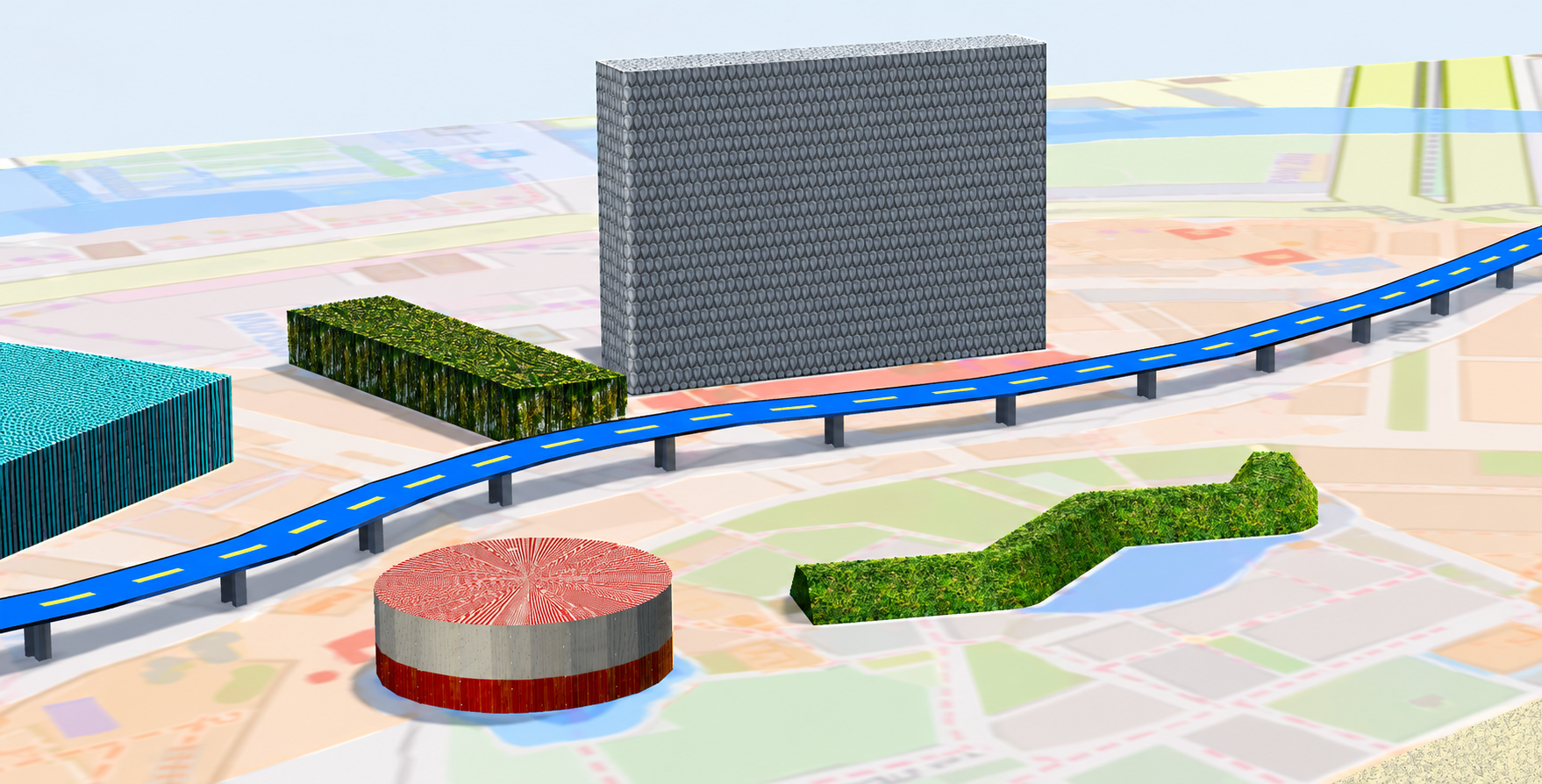
Acoustic Source Definition
Source definitions combine acoustic input data with the represented geometry. Available source types depend on the edition.
Represent individual acoustic emission locations using octave-band sound power spectra.
Supported definitions include stack openings and directional directivity profiles.
Represent road alignments using multi-lane line geometry, including elevated deck heights for bridges and flyovers.
CNOSSOS-EU road emissions can be configured from traffic flow data in Vector and Delta.
Define extended acoustic emission areas using supported polygon source geometry.
Applicable representations include yards, roofs and industrial plant areas.
Model additional industrial source geometries, including tank and industrial polygons.
These extend the core point and road source representation for more complex sites.
Site Geometry
Buildings, barriers and receiver locations form part of the acoustic model. Their geometry influences line of sight and supported sound propagation paths.
Extruded 3D building polygons represent structures that may block direct propagation paths and participate in supported diffraction calculations.
Available in all editionsRepresent rigid acoustic barriers and supported screening geometry. Vector and Delta extend this capability with absorptive screens and advanced roadside barriers.
Core and extended capabilityDefine free-field receiver points and use supported automated façade receptor placement to establish calculation locations.
Available in all editionsRepresent explicit ground zones and foliage attenuation elements where supported by the selected edition and calculation method.
Vector and DeltaModelling Considerations
A sound propagation calculation depends on how acoustic sources, receiver locations and intervening geometry are represented. The selected calculation method determines how those model elements are evaluated.
Source and geometry capabilities vary by edition. Terrain data management, spatial imports and detailed result analysis are covered separately.
Compare core and extended modelling capabilities to determine whether dhwaniPRO or Vector meets your project requirements.